Self-reliance versus dependence
Hayden's TimbreSelf-reliance versus dependence names the struggle between Timbre Simons’s need for material support and her determination not to surrender authority over her own life. The tension shapes her housing, employment, safety, romance, and future plans. Timbre is willing to accept a temporary structure built by Hayden Devillier and the Powell family, but she refuses to mistake protection for ownership or gratitude for obligation. Her recovery depends not on becoming independent in isolation, but on learning whether help can be received without erasing the self that survived without it.
Origins in Deprivation
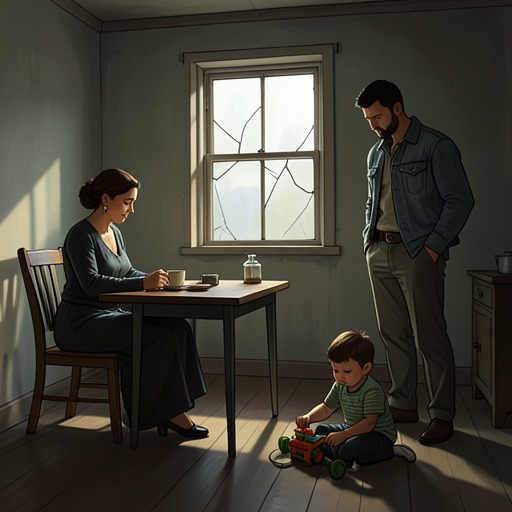
Timbre’s insistence on self-reliance is rooted in a childhood in West Texas marked by calculated, minimal care. Her parents kept her because they received a monthly disability check for her, not because they offered affection or love. She worked from the earliest age possible, saved every penny, and attended college in her city while receiving neither food nor clothing from home. When the payments stopped at eighteen, her parents no longer had a use for her, and she left after graduation. Dependence, in this history, is not associated with safety; it is associated with being treated as a financial resource and discarded when the resource disappears.
That background explains why her later circumstances feel like both rescue and humiliation. She lives in the pool house behind the Powell family home, accepts a job arranged through wealthy friends, and sometimes needs transportation when Hayden Devillier and the musicians are touring; otherwise, she takes the bus from the nearest stop. She recognizes the generosity involved, but she also sees the social distance between herself and the people helping her. Her fear is not merely that she owes them money. She fears becoming a permanent charity case whose identity is reduced to the crisis from which others saved her.
Accepting Shelter Without Surrendering Dignity
Peri Powell presents the pool house as a practical arrangement rather than a favor demanding submission. She explains that the household will often be empty during the week, that she and Assured Distraction may be away on tour, and that Nanny would travel with them, leaving Timbre comfortable in the space. Timbre agrees to move there because she has no room of her own at all, yet her embarrassment is unmistakable when she realizes Hayden Devillier has told Peri where she lived. Peri responds that bad luck has touched everyone and suggests that the arrangement might become a turning point.
The distinction matters to Timbre. She is prepared to accept a home, a salary, and access to opportunities, but she wants each provision to remain temporary and purposeful. When Peri drives her to work, Timbre expresses gratitude for the position at 13 Recordings and promises to be out of the family’s hair as soon as possible. She plans to find an affordable place near work once she is financially stable and believes that her new salary may allow her to rent without a roommate. Peri rejects the language of living off the family, explaining that the pool house is usually empty, that the family has helped musicians before, and that they are happy to help someone whose bad luck has placed her in difficulty. Even then, Timbre continues to define the help as a bridge rather than a destination.
Her response to assistance is active rather than passive. She calculates that the money she saves by avoiding a deposit and rent will accumulate quickly, recognizes that her starting salary exceeds anything she has previously earned, and suspects that Hayden Devillier and his wealthy friends helped secure the job. Instead of treating that advantage as proof of helplessness, she turns it into a plan. She intends to become the best receptionist 13 Recordings has hired, enroll in a master’s program, obtain the license required to open a practice, and repay the people who gave her an opportunity. Writing the plan on paper makes its goals feel real and keeps her moving toward a future in which assistance has produced capacity rather than dependency.
Safety, Control, and the Right to Choose
The conflict becomes sharper when Hayden Devillier finds Timbre Simons returning from a Sunday shopping trip with bags after walking from a distant store. He is alarmed that she has traveled along a busy road and imagines the possibility of a wreck or abduction. His concern is grounded in real danger, but his protective response threatens to become an instruction about how she must conduct her life. Timbre acknowledges that he could have driven her, yet she chose to walk because he had been out late and she wanted to prepare everything for the following morning without disrupting him.
Hayden presses the issue after learning that she may walk to the bus stop again. Timbre refuses to let his fear dictate her movements. She tells him that he cannot tell her how to run her life and insists that she has managed it for a long time. When he moves toward her in anger, she backs away and names the danger in the interaction: he must not bully her into getting his way. Hayden then distinguishes his intention from coercion, explaining that he is worried about the road and wants to prevent harm, but the distinction does not cancel the power imbalance. His offer of protection is loving only if Timbre remains free to refuse it.
Timbre states the principle directly: she appreciates Hayden’s desire to keep her safe, but she cannot allow him to do everything for her. Even a friendship requires her to make her own decisions. The exchange also exposes a romantic uncertainty. Hayden does not see their connection as merely friendship and hopes for more, while Timbre answers that the future remains undecided. Her resistance to dependence is therefore inseparable from her resistance to being absorbed into a relationship on terms established by the person with greater money, mobility, and social power.
Class Difference and Romantic Risk
Timbre’s self-protective logic extends beyond transportation and housing into love. She believes that she and Hayden Devillier move in different circles: he belongs to a prosperous musical world, while she is a receptionist living in his employers’ pool house until she can afford to leave. She does not want to remain in a space that feels like charity, and she assumes that once she is on her feet she will move on. In her view, a woman who fits Hayden’s life should also be able to fit into Crew Devillier’s future, supporting and teaching him in a way she believes she cannot.
She is especially afraid of being interpreted as a gold digger. Peri Powell rejects that accusation and describes Timbre instead as stubborn, proud, and determined to survive. Peri also relays Hayden’s belief that he can offer Timbre safety, happiness, and perhaps love, while emphasizing the scale of what he is risking: his heart, his child, and his life. Timbre can imagine losing only one thing, but it is the thing she most fears losing—her heart. Peri’s challenge is not that Timbre should abandon independence; it is that emotional self-protection can become another form of confinement when it prevents her from choosing intimacy freely.
Timbre also offers Hayden a carefully limited place in her life by saying that she would be glad to help with Crew Devillier and remain his friend. She believes Crew needs time for his father to date and insists that she herself needs only time to get her life running again. This arrangement lets her contribute rather than merely receive. It also reveals her preferred form of dependence: reciprocal responsibility, in which she can give care and practical value even while others provide housing, employment, and transportation.
A Chosen Network Rather Than a Replacement Family
The support surrounding Timbre is powerful precisely because it contrasts with her biological family. When Hayden Devillier leaves her alone because Crew Devillier is ill, she recognizes that his son must take precedence. She accepts the priority even while remembering that her own parents never gave her comparable care. Hayden’s family and friends therefore offer her a new model of dependence: not ownership, contractual maintenance, or neglect disguised as family duty, but a network in which people respond to one another’s needs.
That network has boundaries as well as warmth. Assured Distraction treats Hayden as family in Austin, and Peri warns Timbre that if she hurts him, the band and its close associates will retaliate. The warning is exaggerated into a threat of destruction, but its underlying message is clear: Hayden is protected by chosen family, and entering his life means entering relationships with strong loyalties. Timbre recognizes the intensity of those ties, even as their collective protectiveness makes the social world around Hayden appear still more formidable and unlike her own.
The concept’s significance lies in this unresolved balance. Timbre’s plan to save money, pursue graduate study, obtain a professional license, and eventually rent her own place proves that dependence is not her desired identity. Yet the novel also treats solitary self-sufficiency as inadequate to the dangers she faces and the intimacy she wants. Help from Peri, Hayden, and the Powell household can create the conditions for independence, while Timbre’s insistence on consent prevents that help from becoming domination. Self-reliance is thus revised from a refusal of all assistance into the freedom to accept assistance without surrendering judgment, dignity, or the right to decide what her life will become.